Into the West - the real West.
Dec. 13th, 2005 06:03 pm![[personal profile]](https://www.dreamwidth.org/img/silk/identity/user.png) stoney321
stoney321I went to the Richard Avedon photography exhibit I've been waiting years for. Since this may be the last time they ever compile all of the images again (they are all property of the Amon Carter museum in Ft. Worth, TX), I had to go. Seeing them in a book is nothing like being confronted with a face eight feet high and six feet wide. (Some were even larger) And this is about as confrontational an experience I've had.
The subjects are people you wouldn't talk to. In some cases, people you'd roll the windows up on the car and drive like hell to get away from. One picture was taken in Bexar County (pronounced: Bear by old timers, Bay-har by newscasters) prison. This one inmate, with horribly stitched up wounds on his gut from god-knows what, looks like he's about ready to attack you. His portrait was 10 feet tall. His lip is just beginning to curl up in a sneer.
GAH. I'm getting ahead of myself. Here's a HUGE beef I have with people not from here. Here, meaning Texas and the West. I've lived my whole life in either the Wild West or Texas. My father's family consists of cattle ranchers, farmers, coal miners... My uncle Marvin was the president of the National Rodeo Association for 25 years. My aunt Gaye was a goat ropin' champeen. My dad broke away - he wanted to pursue the higher calling of the arts, like those of his mother's family, who were musicians, inventors, violin makers. His dad died when he was 9 months old, and my grandmother married a man 30 years her senior because he was a successful farmer and could provide, and didn't mind that she had been married before. It was WW2, and a good man was hard to find.
We spent our summers visiting our aunts and uncles in the mountains, completely different from our "city life" in Big D. My mother liked to put on airs that we were very cosmopolitan and ignore her factory working father and other blue-collar family members back in Texas. They were poor, but honest and god fearing - two things she was not. Because I was raised to think I was "better" than those hicks, I always felt like an odd duck. I wasn't better than them, I just had a different accent. From both sets of family. I was shy and quiet, and would sit back and observe. Came to the conclusion that small town life is small town life, just different slang. Well, and in Texas, you prove you love a girl by spray painting her name on an overpass. Out in the mountains, you make her initials with stones on a hillside.
Life is hard and cruel, and if you can't make do, no one feels sorry for you, because everyone has troubles of their own. You do what you can with what you have, resigned that there's not much more. "What else is there?" in a wry tone is pretty much everyone's mantra. It isn't always bleak, it isn't always hard and awful, but - . It's like the flat, featureless land doesn't let you hide anything. When it's bad, it's pretty damned awful. When it's good, it's a change of pace. It's the family gathered on the lawn out by the house on folding chairs for a get-together, and Dixie cups getting blown up against the fence line as a testament to the moment of fun.
![[livejournal.com profile]](https://www.dreamwidth.org/img/external/lj-userinfo.gif) entrenous88 and I stayed up late on IM one night talking about the romanticed idea of poor people. That they can be dirty but beautiful and like to fuck. Because what else is there? I get REAL mad at that overgeneralization. One problem I had with this exhibit was the injections by Laura Wilson, who was Richard Avedon's assistant. (Mother to Luke and Owen, they grew up in one of the more posh neighborhoods, and honey, if we're talking about Dallas, that's saying something.) She has this detatched attitude of "aren't they pitiful but strong? So much wisdom in those eyes..." Lady, it's a trucker on a four day bender. Yeah, he's seen a lot, but he's not Proust in flannel. He beats off to "Hottt Asian Chick" porn and cleans up once a year to go to church and knows Conway Twitty by heart. This... fascination with the "downtrodden" among us as if they have the keys to a "simpler life." Bah.
entrenous88 and I stayed up late on IM one night talking about the romanticed idea of poor people. That they can be dirty but beautiful and like to fuck. Because what else is there? I get REAL mad at that overgeneralization. One problem I had with this exhibit was the injections by Laura Wilson, who was Richard Avedon's assistant. (Mother to Luke and Owen, they grew up in one of the more posh neighborhoods, and honey, if we're talking about Dallas, that's saying something.) She has this detatched attitude of "aren't they pitiful but strong? So much wisdom in those eyes..." Lady, it's a trucker on a four day bender. Yeah, he's seen a lot, but he's not Proust in flannel. He beats off to "Hottt Asian Chick" porn and cleans up once a year to go to church and knows Conway Twitty by heart. This... fascination with the "downtrodden" among us as if they have the keys to a "simpler life." Bah.
None of the subjects were paid for their work. I'll let you draw any conclusions from that.
They're just people. People who live - in many cases - hard lives that I can't fathom. Running away at 13 and following carnivals in shit-water towns in the Dakotas. Following the gypsum mines in West Texas and working 36 hour shifts in a factory that hits 117 degrees every day. On and on. It's fascinating, sure. It drew me in - I stared at each of these pictures (I went through twice, actually) and you can practically hear their stories coming from their faces.
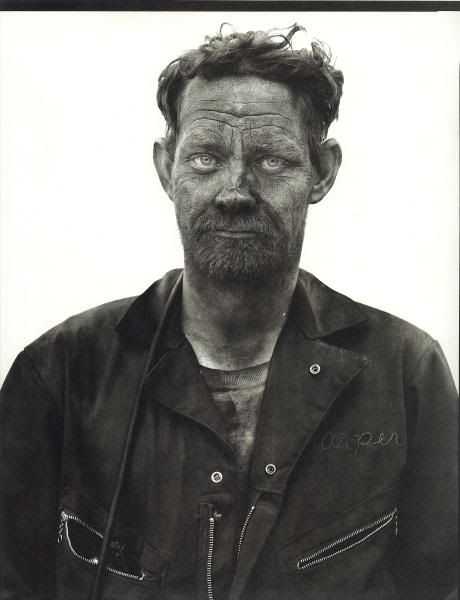
The way the exhibit was set up was effective and very subtle. I didn't notice until I went back through. The walls get darker and darker as you move through the maze of pictures, coinciding with the subject matter. The first pictures are young faces, mostly. Kids who ride around in a truck on Friday night looking for other kids riding around in trucks. A new father, 19 years old. Small town secretaries. Then you move to the drifters, the nuclear fall-out victim, the coal miners, the out of work farmers. Their scarred, lined faces crusted with dirt or soot or ash in sharp contrast to their light colored eyes, or the half inch of clean skin at their hairline from their hard-hats.
Most are looking straight back at you. Some images felt like an intrusion - like they are holding back a long-suffering sigh at my prying. Some faces are open, friendly, others are defiant, some daring you to say anything, and a few made me feel frightened. People I wouldn't dare speak to in real life staring at me, larger than life and in my face.
This man in the upper left corner haunts me. He looks like a caged cat. (I can scan in the larger image if anyone wants any of them. Hell, I paid for the book...)
This drifter - upper right corner - was found in Provo, sitting in a booth and rocking and sobbing. The photographer approached him and listened to his story: down on his luck, drove up north looking for work, car broke down, impounded, he lived in the mountains for three weeks eating berries and such until he finally crawled back down and someone plopped him in the diner for a hot meal. Avedon dropped him off at a shelter - the guy waved him off hours later with a smile and a full belly and noticably higher spirits.
An Indian drifter.
A boy with a freshly killed rattlesnake. Sweetwater, TX, which is out by the oil fields of West Texas and the David mountains, has a Rattlesnake Festival. Everyone goes out and catches them, keeps them in buckets, hauls them back and gets paid $x per pound by the Jaycees. No small town can survive without a local chapter of the Jaycees. Some lucky girl gets crowned Rattler Queen, a dance and feast is later that night. It's looked forward to all year. Fun in a small town. People come from miles and miles from their isolated homesteads.
This boy had a follow up story in the exhibit that just laid me low. Benson James, drifter, Indian. After the exhibit, there was a workroom with letters from the subjects, "how did they's," that sort of thing. They had a letter from this boy's sister. Apparently, he had been murdered a few weeks after this portrait was taken, he was found stabbed 40 times behind a little gas station. The mother found out about him being involved in this project, and was upset at him being called "a drifter." And were there royalties involved.
Here's your typical good-looking cowboy in a small town. He took over the family ranch in Wyoming after his dad was crushed to death by a tractor. He was 17 and engaged when this was taken. They had a follow up picture with him from last year. Wife and kids left him, can barely keep his land - ranching doesn't pay much unless you sell to a big company. Then all you are is a farm hand with no ownership. Aside from his eyes, you could barely tell it was this nice, open-faced kid.
This kid's a meat packer. Hard work in a slaughterhouse. Not the hardest job by a long shot, but hoisting 100-pound slab of packaged meat onto trucks for 12 hours?
This coal miner has amazing eyes. My uncle Mark was a coal miner for years. My aunt Gaye said he would wake up with a cold sweat, screaming from nightmares about cave-ins and no air. Copper mining is just as bad, but far less profitable. Copper is 75 cents to a pound, but costs a buck a pound to get. Why they continue to mine it...
Apparently this exhibit raised a ruckus when it opened in 1985 - this wasn't what people thought the West was. It was John Wayne and sweet blonde girls looking to have babies and keep the homestead. Indians wore headdresses and were proud and tall. Romanticized by Hollywood. But this IS the West. These are people I've seen, people I've avoided, people I've watched. One trip driving out to Utah to visit the family, we were heading through Gallup, NM. Pouring down rain, two-lane highway in the middle of nowhere. My dad traveling one way, an 18-Wheeler coming to us, and a pissed-drunk Indian walking on the yellow diving line in the middle, staggering. My dad saw him right before he swerved to miss, the visibility was so poor. The guy didn't get hurt, but the semi-truck almost jack-knifed off the road trying to miss him, too. Just another day on the Res. If my dad ever sneaks a beer with my husband, he'll start talking about growing up in farm country and the old drifters that follow the herds. I have stories that'll curl your hair. Or... straighten it, if it's already curly. Heh.
If anyone wondered what one of my most favorite movies of all time is (and favorite as in - most affected me, think about more than any other, hit me like nothing else) that would be "The Last Picture Show." Larry McMurtry. Ring a bell? No other movie depicted small town life as perfectly as that did. In fact, it's SO good, you almost squirm in your seat trying to get out, like the kids are. Of course, Jaycee's mom would have WAAAY more make-up in real life, but that movie is so powerful and wonderful and hurty and fantastic.
Blah. I go eat chocolate now.
The subjects are people you wouldn't talk to. In some cases, people you'd roll the windows up on the car and drive like hell to get away from. One picture was taken in Bexar County (pronounced: Bear by old timers, Bay-har by newscasters) prison. This one inmate, with horribly stitched up wounds on his gut from god-knows what, looks like he's about ready to attack you. His portrait was 10 feet tall. His lip is just beginning to curl up in a sneer.
GAH. I'm getting ahead of myself. Here's a HUGE beef I have with people not from here. Here, meaning Texas and the West. I've lived my whole life in either the Wild West or Texas. My father's family consists of cattle ranchers, farmers, coal miners... My uncle Marvin was the president of the National Rodeo Association for 25 years. My aunt Gaye was a goat ropin' champeen. My dad broke away - he wanted to pursue the higher calling of the arts, like those of his mother's family, who were musicians, inventors, violin makers. His dad died when he was 9 months old, and my grandmother married a man 30 years her senior because he was a successful farmer and could provide, and didn't mind that she had been married before. It was WW2, and a good man was hard to find.
We spent our summers visiting our aunts and uncles in the mountains, completely different from our "city life" in Big D. My mother liked to put on airs that we were very cosmopolitan and ignore her factory working father and other blue-collar family members back in Texas. They were poor, but honest and god fearing - two things she was not. Because I was raised to think I was "better" than those hicks, I always felt like an odd duck. I wasn't better than them, I just had a different accent. From both sets of family. I was shy and quiet, and would sit back and observe. Came to the conclusion that small town life is small town life, just different slang. Well, and in Texas, you prove you love a girl by spray painting her name on an overpass. Out in the mountains, you make her initials with stones on a hillside.
Life is hard and cruel, and if you can't make do, no one feels sorry for you, because everyone has troubles of their own. You do what you can with what you have, resigned that there's not much more. "What else is there?" in a wry tone is pretty much everyone's mantra. It isn't always bleak, it isn't always hard and awful, but - . It's like the flat, featureless land doesn't let you hide anything. When it's bad, it's pretty damned awful. When it's good, it's a change of pace. It's the family gathered on the lawn out by the house on folding chairs for a get-together, and Dixie cups getting blown up against the fence line as a testament to the moment of fun.
entrenous88 and I stayed up late on IM one night talking about the romanticed idea of poor people. That they can be dirty but beautiful and like to fuck. Because what else is there? I get REAL mad at that overgeneralization. One problem I had with this exhibit was the injections by Laura Wilson, who was Richard Avedon's assistant. (Mother to Luke and Owen, they grew up in one of the more posh neighborhoods, and honey, if we're talking about Dallas, that's saying something.) She has this detatched attitude of "aren't they pitiful but strong? So much wisdom in those eyes..." Lady, it's a trucker on a four day bender. Yeah, he's seen a lot, but he's not Proust in flannel. He beats off to "Hottt Asian Chick" porn and cleans up once a year to go to church and knows Conway Twitty by heart. This... fascination with the "downtrodden" among us as if they have the keys to a "simpler life." Bah.None of the subjects were paid for their work. I'll let you draw any conclusions from that.
They're just people. People who live - in many cases - hard lives that I can't fathom. Running away at 13 and following carnivals in shit-water towns in the Dakotas. Following the gypsum mines in West Texas and working 36 hour shifts in a factory that hits 117 degrees every day. On and on. It's fascinating, sure. It drew me in - I stared at each of these pictures (I went through twice, actually) and you can practically hear their stories coming from their faces.
The way the exhibit was set up was effective and very subtle. I didn't notice until I went back through. The walls get darker and darker as you move through the maze of pictures, coinciding with the subject matter. The first pictures are young faces, mostly. Kids who ride around in a truck on Friday night looking for other kids riding around in trucks. A new father, 19 years old. Small town secretaries. Then you move to the drifters, the nuclear fall-out victim, the coal miners, the out of work farmers. Their scarred, lined faces crusted with dirt or soot or ash in sharp contrast to their light colored eyes, or the half inch of clean skin at their hairline from their hard-hats.
Most are looking straight back at you. Some images felt like an intrusion - like they are holding back a long-suffering sigh at my prying. Some faces are open, friendly, others are defiant, some daring you to say anything, and a few made me feel frightened. People I wouldn't dare speak to in real life staring at me, larger than life and in my face.
This man in the upper left corner haunts me. He looks like a caged cat. (I can scan in the larger image if anyone wants any of them. Hell, I paid for the book...)
This drifter - upper right corner - was found in Provo, sitting in a booth and rocking and sobbing. The photographer approached him and listened to his story: down on his luck, drove up north looking for work, car broke down, impounded, he lived in the mountains for three weeks eating berries and such until he finally crawled back down and someone plopped him in the diner for a hot meal. Avedon dropped him off at a shelter - the guy waved him off hours later with a smile and a full belly and noticably higher spirits.
An Indian drifter.
A boy with a freshly killed rattlesnake. Sweetwater, TX, which is out by the oil fields of West Texas and the David mountains, has a Rattlesnake Festival. Everyone goes out and catches them, keeps them in buckets, hauls them back and gets paid $x per pound by the Jaycees. No small town can survive without a local chapter of the Jaycees. Some lucky girl gets crowned Rattler Queen, a dance and feast is later that night. It's looked forward to all year. Fun in a small town. People come from miles and miles from their isolated homesteads.
This boy had a follow up story in the exhibit that just laid me low. Benson James, drifter, Indian. After the exhibit, there was a workroom with letters from the subjects, "how did they's," that sort of thing. They had a letter from this boy's sister. Apparently, he had been murdered a few weeks after this portrait was taken, he was found stabbed 40 times behind a little gas station. The mother found out about him being involved in this project, and was upset at him being called "a drifter." And were there royalties involved.
Here's your typical good-looking cowboy in a small town. He took over the family ranch in Wyoming after his dad was crushed to death by a tractor. He was 17 and engaged when this was taken. They had a follow up picture with him from last year. Wife and kids left him, can barely keep his land - ranching doesn't pay much unless you sell to a big company. Then all you are is a farm hand with no ownership. Aside from his eyes, you could barely tell it was this nice, open-faced kid.
This kid's a meat packer. Hard work in a slaughterhouse. Not the hardest job by a long shot, but hoisting 100-pound slab of packaged meat onto trucks for 12 hours?
This coal miner has amazing eyes. My uncle Mark was a coal miner for years. My aunt Gaye said he would wake up with a cold sweat, screaming from nightmares about cave-ins and no air. Copper mining is just as bad, but far less profitable. Copper is 75 cents to a pound, but costs a buck a pound to get. Why they continue to mine it...
Apparently this exhibit raised a ruckus when it opened in 1985 - this wasn't what people thought the West was. It was John Wayne and sweet blonde girls looking to have babies and keep the homestead. Indians wore headdresses and were proud and tall. Romanticized by Hollywood. But this IS the West. These are people I've seen, people I've avoided, people I've watched. One trip driving out to Utah to visit the family, we were heading through Gallup, NM. Pouring down rain, two-lane highway in the middle of nowhere. My dad traveling one way, an 18-Wheeler coming to us, and a pissed-drunk Indian walking on the yellow diving line in the middle, staggering. My dad saw him right before he swerved to miss, the visibility was so poor. The guy didn't get hurt, but the semi-truck almost jack-knifed off the road trying to miss him, too. Just another day on the Res. If my dad ever sneaks a beer with my husband, he'll start talking about growing up in farm country and the old drifters that follow the herds. I have stories that'll curl your hair. Or... straighten it, if it's already curly. Heh.
If anyone wondered what one of my most favorite movies of all time is (and favorite as in - most affected me, think about more than any other, hit me like nothing else) that would be "The Last Picture Show." Larry McMurtry. Ring a bell? No other movie depicted small town life as perfectly as that did. In fact, it's SO good, you almost squirm in your seat trying to get out, like the kids are. Of course, Jaycee's mom would have WAAAY more make-up in real life, but that movie is so powerful and wonderful and hurty and fantastic.
Blah. I go eat chocolate now.


![[identity profile]](https://www.dreamwidth.org/img/silk/identity/openid.png)


no subject
Date: 2005-12-13 04:57 pm (UTC)I was the first person in my family ever to graduate from college. The night I graduated, my grandmother sobbed. We were free, and it was the values and determination that they gave us to do so...
Your essay brought me to tears, more than once. So beautiful...haunting...
thank you.
no subject
Date: 2005-12-13 05:50 pm (UTC)And right with the defiant look. If you see the exhibit book in a bookstore, I highly recommend you flip through it. This is a teeny sampling of the hundreds of pictures he took.
no subject
Date: 2005-12-13 05:59 pm (UTC)He photograped people like Ansel Adams photographed nature--stark, unforgivable truth, without shadows or touchups to hide the scars and sins...
no subject
Date: 2005-12-13 06:04 pm (UTC)Me, too.
no subject
Date: 2005-12-13 06:23 pm (UTC)no subject
Date: 2005-12-13 05:16 pm (UTC)no subject
Date: 2005-12-13 05:52 pm (UTC)no subject
Date: 2005-12-13 05:27 pm (UTC)no subject
Date: 2005-12-13 06:03 pm (UTC)I think what made this controversial when it first showed (and it was - the Star Telegram, Ft. Worth's paper - was LIVID. "This isn't our west! This isn't what ranchers and oil barons look like!") was that people didn't look like a John Wayne movie. People had hard, ugly jobs, and they put their heads down and went about life and weren't this romanticized ideal.
I never understood how in love with my girlfriend this boy from Chilicothe was, until his friend told me he had spray painted her name on the overpass. That there's courtship.
no subject
Date: 2005-12-13 06:34 pm (UTC)Not too long ago, CMT did a *reality show* in Vega, Tx. and brought in all of the urban people from Chicago, and LA, and New York, and Portland. And I swear, it was the funniest thing to watch because they just couldn't imagine people *lived* like that... willingly. I bet I laughed for 20 minutes when they assigned them the task of finding a job application from a business in town. That was just cruel on the part of the show!
And yes, the kids usually have no greater need at graduation than to get as far from town as possible. But they usually go back. Because as hard as that life is, it is much more black and white. You know the score. And better the devil you know...
And I can't imagine why Ft Worth would say it wasn't their west. It is. For every one of those people, I could find another dozen like them without traveling more than 30 minutes away. And Ft Worth was built by them. The barons may have owned everything, but it was the workers who made them what they were.
And yes...highschool football is the predominante religion!
no subject
Date: 2005-12-13 07:11 pm (UTC)My husband worked for an oil company for a while - you'd be amazed at how many of the oil workers that are stationed at solo rigs commit suicide.
Land of the Big Sky. Too big, for some.
no subject
Date: 2005-12-13 07:34 pm (UTC)I guess the outrage shouldn't surprise me, I hear plenty of people opine that DFW and Houston have forgotten from wence they came. But I think a lot of it is just that they are several generations into the city. Even if they live in Texas, the reality of small town and rural life is as foreign to them as another country.
And I can even see that a lot of them don't want the world to see that side of "the west". That it's progressed and those hardships and rough edges have all been smoothed over.
no subject
Date: 2005-12-13 06:04 pm (UTC)no subject
Date: 2005-12-13 06:07 pm (UTC)There was this one picture of an out of work cotton farmer and his wife, and at first, he looks so proud and defiant, then the longer you look, there's a fear and sadness in his eyes. BAH. I need to upload more pics. And I cannot stress how much more of an affect they had when blown up to almost 10 feet in height.
*hugs you, hopes you are well tonight*
no subject
Date: 2005-12-13 06:09 pm (UTC)no subject
Date: 2005-12-13 06:18 pm (UTC)It's there through... Jan. 6? I'd go again, ahem.
no subject
Date: 2005-12-13 06:21 pm (UTC)Right now I feel like one of those photo subjects, really I do. Sigh. The one titled "aging educational bureaucrat faces result of many bad choices."
Later!
no subject
Date: 2005-12-13 06:26 pm (UTC)Friday the 30th? Say when and I'm there.
no subject
Date: 2005-12-13 06:28 pm (UTC)no subject
Date: 2005-12-13 06:11 pm (UTC)I have photos I feel like I shouldn't have taken, and photos that I didn't take, for similiar reasons. One of the best pictures I've ever taken is a man in a church in Savannah, and I love the picture but no one who has seen it can see there what I see. Even with all the context in the photo I feel like what I wanted to get with the picture just isn't possible. In Bermuda, I didn't take a picture of the man I had a long conversation about art & representation with because he was right and there was no way I could take the picture and have it mean what it meant to the two of us. The second I walked away that meaning was gone. Maybe that guy is still getting to me and I haven't reconciled that conversation with my own work and that is why Avedon's phtos nag at me.
I don't think I'm making sense and wow I can ramble so I'm shutting up now. I do agree with what you said about the photos and small town life. It is just the photos themselves and the act of someone having taken them and what my uneasiness means for my own work that I can't get my head around.
no subject
Date: 2005-12-13 06:25 pm (UTC)Laura Wilson is who bothered me. Her words and mentality - very Henry Higgins with the watching and distancing herself from who they were, or romanticising their life because it's an interesting subject. What I've heard of Avedon, he sat down, talked with, kept up correspondence with these people.
There's one person that had to be cajoled into getting his picture taken, in the link up above with the three pics? The bottom left. And his is haunting.
But think about some of the most powerful photography - the image of the little girl covered in napalm. God, I could tear up thinking about it. but it's an important picture. It's the gratuitous ones that are there for the artist's satisfaction that upset me. The ones that try and make sense, or at least honestly portray the subject don't make me feel bad from an observation stand point. They're like a doorway into something I didn't know about, almost. Make sense?
He used an old camera to take the pictures, so they had to stand still for 30 seconds while the image was snapped. He would talk to them and connect while they stood stock still. Amazing.
And again, this was the most confrontational experience with art (aside from theater) I've ever had. But in a good way.
no subject
Date: 2005-12-13 06:57 pm (UTC)I should send you a scan of the picture of the guy in Savannah and see what you make of it.
no subject
Date: 2005-12-13 07:05 pm (UTC)no subject
Date: 2005-12-13 07:01 pm (UTC)But, thank you for sharing this and your thoughts. I am often amazed by the thought of how the thinnest of connections can make the most lasting impression. Does that make sense at all? Likely not. But still - thank you.
no subject
Date: 2005-12-13 07:07 pm (UTC)no subject
Date: 2005-12-13 10:07 pm (UTC)They're just people.
We trip over ourselves to avoid this fact, we create racism and sexism, we give more merit based on the answers given to a man in a suit and a tie, we pour our glossy magazines filled with celebrities, we create the humble noble poor person, or the sophisticated debonair heiress, we take personality tests and pidgeon hole according to type. And yet it's all just bullshit because we're all just so painfully similar underneath it all and so busy trying to create this idea of the uber-individual inbetween categorising everyone to type.
Can I blame the marketing people? No? Heh.
You go eat chocolate. It'll be good for that PMS. (kidding)
An A grade post, you're good at those.
no subject
Date: 2005-12-14 06:06 am (UTC)Bad analogy, but you get my point. I don't like "art" where the arteest is deigning to roll in the muck and the filth because, oh, these people "know." They've "experienced." His assistant struck me that way EVERY. TIME. SHE TALKED. He seemed genuinely interested/curious/empathetic.
GAH, I wished you lived closer so we could sit on a bench and talk for hours about this stuff. I had so much fun talking with you last time.
no subject
Date: 2005-12-14 04:25 am (UTC)And I really appreciated what you say about people and how they get to be represented, and who by. I work with communities sometimes...there are lots of buzzwords like empowerment, self-representation, around how the relationship should go - basically the need for whoever gets to direct what's happening not to be a prat.
I could get boring now going on about power relationships and art and what art is for, so I'll stop. Hey! My daughter made cornbread muffins from your recipe, they were delicious!
no subject
Date: 2005-12-14 06:15 am (UTC)I would really be interested to hear about the lives of tribesmen in developing places in Afric, as compared to the native Indians, here. I think the difference would be the lack of obliteration of their culture. The Indians' entire way of life was detroyed, which is why so many of them drift aimlessly in the west, broken and lost.
"The need for whoever gets to direct what's happening not to be a prat." I suspect that's along the lines of the "thinking, feeling white man's comfort," yes?
It was fascinating to read letters from the subjects of the photos, or from their families, in response to the pictures. And how years later they had come to terms with it, enjoyed the noteriety, hated that they didn't smile...
no subject
Date: 2005-12-14 08:52 am (UTC)My mum was from a mining village in the North East of England, first person in her family in higher education. She had a lot of issues about class which I may well have inherited. It makes for an interesting, very ambiguous mixture. I think.
no subject
Date: 2005-12-15 06:32 am (UTC)I like to hide behind facts and information so I don't get beat down by the brutality of hardship some people are sucked down in, but enabling me to participate in some fashion. So basically, I'm an ass. :D
no subject
Date: 2005-12-14 06:12 am (UTC)I don't have family background to draw upon for personal experience similar to yours; my grandparents did live in a small town in the mountains of North Carolina but they were at least one generation removed from farming or other manual work. They were teachers or office workers and while they worked hard by their standards, it was nothing like the back-breaking work done by the subjects of these photos.
But I have seen some faces like those before -- it was overseas, in Southeast Asia. I'm sure you'll agree that the human experience of misery and *endurance* of that misery is universal.
no subject
Date: 2005-12-14 06:25 am (UTC)There was a story that accompanied an image of a gypsum-mine worker (here in Texas). This guy had worked for 36 straight hours hoisting 100-pound bags of gypsum onto his back and onto a truck. It was 117 degrees inside the warehouse, dust in the air, he was coated. He walked out for the end of his shift, they stood him up against the backdrop. You can't move for 30 seconds while the camera takes the image, and it was all he could do to not sway on his feet. He fainted right after the shutter clicked, apologizing.
The guy was this burly, muscled, rough-faced man coated in mud and white powder, and his eyes can barely be seen through the swollen lids.
no subject
Date: 2005-12-14 07:53 am (UTC)no subject
Date: 2005-12-14 11:03 am (UTC)no subject
Date: 2005-12-14 11:01 am (UTC)This is at the Amos Carter Museum in Ft. Worth. (Next to the Kimball.) Only there for two? Three more weeks?
no subject
Date: 2005-12-14 05:51 pm (UTC)I love when a museum uses the actual space to contribute to the experience of the show. The children's (all we had time for) exhibit in the Holocaust Museum got colder and somehow, danker, as you progressed.
::squishes you tight::
no subject
Date: 2005-12-15 06:34 am (UTC)*holds your hand tighter* Hi, Susi-Q.