Tillandsias and Orchids
Jan. 26th, 2007 09:05 am![[personal profile]](https://www.dreamwidth.org/img/silk/identity/user.png) stoney321
stoney321In the middle of yesterday's drama llama with my kid (we're done talking about it for now, k?) I went to a Master Gardening meeting where to my surprise, Gunter Schnetzinger of Gunter's Greenhouse was giving a lecture on orchids, their care, propagation, and talked at length about Tillandsias, which are air plants. (epiphytic, translation: COOL AND EASY.)
Gunter (who looks exactly like Santa Claus and had a thick German accent) had at least five of each genus of orchids for display. Gllaaaaah. The most gorgeous Lady Slippers (from him: easiest of orchids to care for, and I agree) to exotic Cattleyas (one of them I could smell from the back of the room - like fresh lilies. YUM.) But what was most interesting was the display of "air plants" he brought, of the genus Tillandsia. Here are some examples. (eeeeeee! I'm tewtally ordering the grouped ones today) I'll get to those in a bit.
The reason Lady Slippers are the easiest is due to where they grow: the floor of a forest. Little light, grab food from decaying leaves/ forest floor detritus, and minimal water. Ah! Phalaeonopsis orchids are the second easiest to grow, for just about the same reasons.
ORCHIDS
Tips he had for us on growing/propagation for all orchids:
I'm totally repotting my orchids today. Eeek. I may have beautiful displays in large glass specimen jars (I love that look) but my one Oncidium hasn't rebloomed, and I think it's got too much root space. That's what Gunter told me, any way. (Isn't that a gorgeous plant??)
Tillandias
So, they grow in the AIR. No soil. Bromeliads are in this family, but I don't particularly care for the succulent-leaved Bromeliads, personally. Once they've flowered, those are done. I like the ones linked above because a) they propagate babies, so more plants, yay! b) they require less care c) they look amazing in displays. The ones he showed us were LITERALLY laying on top of things. Like, he had one that formed a ball, so he had a wooden dowel in a pretty vase with the ball plant balancing on top. And then a few smaller plants laying around the opening of the vase. It looked like an elegant topiary. Too cool.
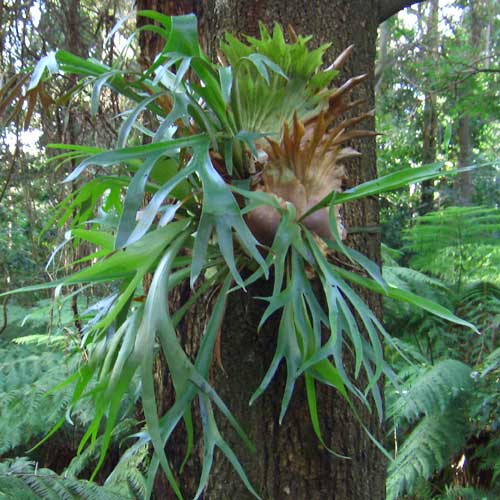
Some of the more interesting ones with long tendrils for flowers or leaves he had attached to things like driftwood or natural cork. Here's how to attach a plant to driftwood: (I have a Staghorn Fern on display like this in my house, for example. Mine isn't as large as the one in the photo - not yet!)
DISPLAY
Gunter recommended that you angle the plants: don't make the center straight up, in other words. They don't grow that way naturally, and it's to keep water from collecting on the crown, which will kill it. Some of these can grow upside down, too! And keep in mind you don't HAVE to mount them. They can lay on a tray of gravel or sand as an object d' arte and be perfectly happy. You'll just mist the root (again, don't let water collect on the crown/space between the leaves) once a week, or twice - as needed. I've seen amazing displays of these plants - they look so beautiful and funky.
CARE:
You don't want to over or underwater these plants. They're indigenous to places like Costa Rica, so they get regular watering, and rainfall is in the morning, typically. Every week (maybe twice a week if it's very dry and warm in your house) you'll moisten the medium - the moss in the above example. Let any excess water RUN OFF. The old idea of pouring water in the "cups" of Bromeliads? That's a huge no no and will kill the plant. Gunter recommended having a smattering of fertilizer in the water for EACH watering. 1/4 tsp of orchid fertilizer per gallon was his example. And that mix will last you all summer long. (Store in cool place like bottom of pantry, away from light.)
These plants like bright, INDIRECT light. That means: don't hang them in the window right next to the glass on a Western/Southern side of your house. You'll burn them. Perfect conditions would be three feet away (or, if you have light drapes over those windows, closer) from a Western/Southern window, or in an Eastern window - that's ideal.
Filtered light in Costa Rica is the natural air - there's so much moisture in the air, it protects the flora below. Now, in Texas, for example, we have next to NO moisture in the air, so the sun blasts down on everything below. Huh!
If you live up north, or in Europe, you can bring them outside when the outside temperature is over 55. 55 - 85 degrees Fahrenheit is ideal. Just remember: not in DIRECT sunlight. Put them under trees, under a canopy, on the patio where there are other plants to deflect some of the directness of the sun. You will need to water more often in the hot summer months. Orchids and other epiphytes look SO COOL hanging under trees - that's how they exist in nature. Too bad it's too hot here to really pull it off- it just takes too much effort, and I like to ENJOY my garden, not constantly work in it.
Now, my Staghorn fern (which has the same care needs as these air plants) gets dumped in the sink with TEPID water (temperature affects plants, so don't use cold or hot water for ANY plant) with an appropriate amount of fertilizer once a week. I set it on a drain pan after it's soaked for a couple of minutes, and when the water's done running off, I hang it back up. I've had it for several years now. (I then pour that water from the sink into a bucket and water the remaining house plants, because it's all about conservation, yo.
I'm about to head out to the garden center for more potting medium and I'm going to geek out over plants today. (I have a bunch of new succulents that arrived this week, so I'm replanting my specimen jars with succulents, instead of having them as terrariums for my ferns. Yay!) <-- complete dork
Gunter (who looks exactly like Santa Claus and had a thick German accent) had at least five of each genus of orchids for display. Gllaaaaah. The most gorgeous Lady Slippers (from him: easiest of orchids to care for, and I agree) to exotic Cattleyas (one of them I could smell from the back of the room - like fresh lilies. YUM.) But what was most interesting was the display of "air plants" he brought, of the genus Tillandsia. Here are some examples. (eeeeeee! I'm tewtally ordering the grouped ones today) I'll get to those in a bit.
The reason Lady Slippers are the easiest is due to where they grow: the floor of a forest. Little light, grab food from decaying leaves/ forest floor detritus, and minimal water. Ah! Phalaeonopsis orchids are the second easiest to grow, for just about the same reasons.
ORCHIDS
Tips he had for us on growing/propagation for all orchids:
- water them regularly, say once a week. Let the water DRAIN OFF. Do NOT let any orchid sit in water. Plastic pots, although ugly, are really the best for all orchids. Slip them in a pretty pot for the displaying, but let the roots be in plastic. If you have water puddling on the crown, BLOT IT OFF.
- adjust the light if you aren't getting blooms, but realize plants ONLY BLOOM in their designated time. You can't get a Lady Slipper that blooms now (Jan- Feb) to bloom in August. Cattleyas and Cimbidiums like the most light. They can grow on the Western/Southern side. The rest should be on the eastern, or back from the window. (Lady Slippers were prized by the Victorians, and their houses weren't bright, to say the least.)
- re-pot an orchid when it's done blooming. He feels that the plants get the most out of the new potting medium here in Texas, as our water is very alkaline. If you live where you have more acidity in your soul, re-pot every two years, or two blooming cycles.
- when the bloom is done (and most blooms should last for a few months, some for EIGHT!!) cut off the stalk down to the second node from the base. (look at the stem. You'll see "knees" every few inches up the length. Those are "nodes." Cut just above the second one, and at an angle so water doesn't sit on the cut end.)
- for fungus on your orchid, use GROUND CINNAMON! Translation: black spot with a yellow halo? Lick your finger, stick it in the cinnamon (*g*) and then rub that on the spot. Voila!
- re-potting when the orchid is "climbing out" of the pot: the part that is crawling out of the pot is the NEW GROWTH. This is important. Count backwards FOUR BULBS. (each of the succulent stems in this picture are "bulbs") You can then cut through the bottom rhizome (looks like an albino potato) and there's your new plant. Pot that. You can then continue backwards on the plant, making cuts every four bulbs and have new orchids. The final oldest part is called the "back bulb" and is very difficult to get to produce new growth. Incidentally, he claims that most commercial growers who sell bulbs are selling you this part online. BUY IN A STORE he says. I agree. you can also dust the cut ends of the plant with cinnamon, if fungus has been a problem in the past.
- when re-potting, keep in mind that orchids like SMALL SHOES. They like their roots confined. Use quality orchid potting medium, and only go up one size in pots. If you're dividing a plant, you'll want a smaller pot than before for each cutting. When dividing, the aerial roots that were hanging over the edge can now be tucked down into the pot. It's okay for those to hang out, by the way, as long as the plant receives adequate light and moisture, never sitting in water.
I'm totally repotting my orchids today. Eeek. I may have beautiful displays in large glass specimen jars (I love that look) but my one Oncidium hasn't rebloomed, and I think it's got too much root space. That's what Gunter told me, any way. (Isn't that a gorgeous plant??)
Tillandias
So, they grow in the AIR. No soil. Bromeliads are in this family, but I don't particularly care for the succulent-leaved Bromeliads, personally. Once they've flowered, those are done. I like the ones linked above because a) they propagate babies, so more plants, yay! b) they require less care c) they look amazing in displays. The ones he showed us were LITERALLY laying on top of things. Like, he had one that formed a ball, so he had a wooden dowel in a pretty vase with the ball plant balancing on top. And then a few smaller plants laying around the opening of the vase. It looked like an elegant topiary. Too cool.
Some of the more interesting ones with long tendrils for flowers or leaves he had attached to things like driftwood or natural cork. Here's how to attach a plant to driftwood: (I have a Staghorn Fern on display like this in my house, for example. Mine isn't as large as the one in the photo - not yet!)
DISPLAY
- Take your plant. See the long taproot? It's best if you can affix that inside a crevice of some sort on driftwood or a clay pot or somesuch.
- Carefully wrap the tap root in some moistened Spanish moss (not LIVING moss - like, if you live in the deep South, don't yank some off a tree. That's not been processed to kill the parasite, which is what Spanish Moss is - like mistletoe)
- Set that bundle on the crevice or in the wooden cage - Home Depot sells these. They're great and cheap.
- Use something like natural fiber or raffia to wrap around the item you're putting the plant on. A few circles is all you'll need - the plants don't weigh much. If you want to hide this binding with some more moss, knock your socks off.
Gunter recommended that you angle the plants: don't make the center straight up, in other words. They don't grow that way naturally, and it's to keep water from collecting on the crown, which will kill it. Some of these can grow upside down, too! And keep in mind you don't HAVE to mount them. They can lay on a tray of gravel or sand as an object d' arte and be perfectly happy. You'll just mist the root (again, don't let water collect on the crown/space between the leaves) once a week, or twice - as needed. I've seen amazing displays of these plants - they look so beautiful and funky.
CARE:
You don't want to over or underwater these plants. They're indigenous to places like Costa Rica, so they get regular watering, and rainfall is in the morning, typically. Every week (maybe twice a week if it's very dry and warm in your house) you'll moisten the medium - the moss in the above example. Let any excess water RUN OFF. The old idea of pouring water in the "cups" of Bromeliads? That's a huge no no and will kill the plant. Gunter recommended having a smattering of fertilizer in the water for EACH watering. 1/4 tsp of orchid fertilizer per gallon was his example. And that mix will last you all summer long. (Store in cool place like bottom of pantry, away from light.)
These plants like bright, INDIRECT light. That means: don't hang them in the window right next to the glass on a Western/Southern side of your house. You'll burn them. Perfect conditions would be three feet away (or, if you have light drapes over those windows, closer) from a Western/Southern window, or in an Eastern window - that's ideal.
Filtered light in Costa Rica is the natural air - there's so much moisture in the air, it protects the flora below. Now, in Texas, for example, we have next to NO moisture in the air, so the sun blasts down on everything below. Huh!
If you live up north, or in Europe, you can bring them outside when the outside temperature is over 55. 55 - 85 degrees Fahrenheit is ideal. Just remember: not in DIRECT sunlight. Put them under trees, under a canopy, on the patio where there are other plants to deflect some of the directness of the sun. You will need to water more often in the hot summer months. Orchids and other epiphytes look SO COOL hanging under trees - that's how they exist in nature. Too bad it's too hot here to really pull it off- it just takes too much effort, and I like to ENJOY my garden, not constantly work in it.
Now, my Staghorn fern (which has the same care needs as these air plants) gets dumped in the sink with TEPID water (temperature affects plants, so don't use cold or hot water for ANY plant) with an appropriate amount of fertilizer once a week. I set it on a drain pan after it's soaked for a couple of minutes, and when the water's done running off, I hang it back up. I've had it for several years now. (I then pour that water from the sink into a bucket and water the remaining house plants, because it's all about conservation, yo.
I'm about to head out to the garden center for more potting medium and I'm going to geek out over plants today. (I have a bunch of new succulents that arrived this week, so I'm replanting my specimen jars with succulents, instead of having them as terrariums for my ferns. Yay!) <-- complete dork


![[identity profile]](https://www.dreamwidth.org/img/silk/identity/openid.png)



no subject
Date: 2007-01-26 03:17 pm (UTC)Well, one of the reasons I have my orchids in specimen jars (they're really cookie jars - 5 gallon size - from Target, but they look like 19th century lab jars) is to maintain humidity, also. We have very little moisture in the air, too. If you WANTED (and I'm not pushing) but if you WANTED to grow orchids again, you could put a cloche (those bell shaped glass jars?) or a large glass container over the plant during the growing season, and that will keep the moisture level up.
Or just dunk the plant in the sink once a week for deep soaking.
Or you know... don't grow them. Hah! I'm such a plant pusher.
no subject
Date: 2007-01-26 03:25 pm (UTC)Yeah... it's time to not waste any more money. Sheesh! *sends you tickets to Orchid Shows to give you some pleasure...*
no subject
Date: 2007-01-26 03:22 pm (UTC)So orchids - well, maybe I’ll be brave, having read your post and see what happens.
no subject
Date: 2007-01-26 03:27 pm (UTC)You can do it! *claps hands* (And you can always ask me for help/advice. I may not have the answer, but I can certainly find someone who does!)
no subject
Date: 2007-01-26 04:16 pm (UTC)Then we got Lump.
Mighty Lump, killer of bugs, mice and plants. Seriously. The only living things in the house she hasn't killed are the other cat and me and Rick. And I'm sure she's tried to kill Gabe and is just plotting how to kill Rick. (She won't kill me because I have The Lap With The Fleece Blanket. She's a fabric whore)
The orchid was her first victim. She ate all the buds. Then started on the leaves. Everytime someone gives me a plant it has to come into work. Once we had to de-clutter our cubes and I asked the boss if that included the plants, because, as I told her, if I took the plants home the cat would have to come to work.
I was so proud of how long I kept that orchid alive. *sigh*
no subject
Date: 2007-01-26 04:29 pm (UTC)Or you know, stick with bringing them to work. :D
no subject
Date: 2007-01-26 07:04 pm (UTC)What I love about orchids, beyond all else, is how very long they keep their blooms. The white Phal. in the photo still looks just like that, four weeks on. Since I bought my first orchid at Trader Joe's because it was cheaper than cut flowers, it needs mention that they also last much longer than cut flowers.
Also, about buying orchids in stores: pay attention to the color of the flower bud stems. (The proper botanical term has not survived four nights running of few hours of restless sleep. Petiole?) Anyway, if they're yellow or white instead of deep green, the bud will drop unopened. I lirnd this the hard way, duh.
Julia, accidentally taking naproxen twice before bedtime=persistant ouch
no subject
Date: 2007-01-26 07:51 pm (UTC)What happened to the Tillandsias?
no subject
Date: 2007-01-27 03:36 am (UTC)They just ceased to be, one spikey little leaf at a time. Sad, but hard to diagnose; the Tillandsia specialists at the Northwest Flower and Garden Show said it could have been fungus, or acid fog.
Julia, it was all very distressing
no subject
Date: 2007-01-26 09:23 pm (UTC)Oooooh, succulents! *moohhhnches on thems*
no subject
Date: 2007-01-26 09:45 pm (UTC)The succulent wreath!! I want it. I WANT TO MAKE IT. *gets out seedling mix*
no subject
Date: 2007-01-26 09:46 pm (UTC)no subject
Date: 2007-01-26 10:22 pm (UTC)One year, I had both fish and a fern, and in my zeal to keep from forgetting to feed/water the creatures, I overfed/overwatered, and they died anyway. I had no idea that plants could drown--it's not the kind of thing people mention. Also, there's nothing more depressing in the world than finding a morbidly obese goldfish floating at the top of his bowl.
When we had a plant in my first apartment, I'm pretty sure my roommates were trying to find ways to torture it. (For example, I've read that plants like classic musical, and flourish if you play stuff like Beethoven or Mozart--they played GWAR all the time) Mike's girlfriend, Quiet Kate, waged a kind of war with us trying to protect Lenny (the plant) and keep him healthy, but it was all for naught.
Basically, I need a "Boy Meets Boy" icon of the strip where Mik and Harley talk about getting a plant and Mik reminds Harley, "We had a plant. You never watered it. It died alone and in misery."
...I'm a bit rambly today, sorry. Thanks for posting this, anyway--I'll send it to my brothers, who are better are keeping plants alive than me. ;-)
no subject
Date: 2007-01-29 09:46 pm (UTC)no subject
Date: 2007-01-31 02:35 pm (UTC)no subject
Date: 2007-01-31 02:54 pm (UTC)no subject
Date: 2007-01-31 02:59 pm (UTC)I'm looking at my Lady Slipper right now - I don't think it'll open today - I've been waiting for about a month. *rubs hands excitedly*
no subject
Date: 2007-01-31 03:03 pm (UTC)no subject
Date: 2007-01-31 03:09 pm (UTC)(this is Stoney, I'm just too lazy to log out of my RP journal. *g*)
no subject
Date: 2007-01-31 03:17 pm (UTC)And I was really curious when I found that "booty hunter" had left me a message...
Oh, there are a few flower pics in my flickr account. I especially love the daffodils here. EVERYWHERE.
no subject
Date: 2007-01-31 09:48 pm (UTC)no subject
Date: 2007-04-18 01:07 pm (UTC)no subject
Date: 2007-04-18 01:10 pm (UTC)no subject
Date: 2008-05-12 04:35 pm (UTC)My Mom bought me a Phalaenoposis Orchid about a month ago and in that time the four flowers it had on it wilted and dropped off and the stem has turned from a deep red at the base to an orangish color from the middle to the top. Is this due to the water quality, not enough water, too much water, or is it just supposed to do that and I'm worrying about it for nothing?
It's in a very small pot so I've been watering it 2x a week (when the mossy looking stuff poking out of the bottom is dry). The leaves are bright green and producing four little red "knobs" that look very similar to the stem the flowers grew on but are facing down instead of up. Are these additional roots? Do I need to do anything with them?
The leaflet (no pun intended hehe) that came with the plant says that it thrives in a "high light / low light" environment, so I stuck it on my window sill above the kitchen sink where it gets a lot of light but none direct. Does this sound adequate? And how do I know if the plant needs repotted now versus later? I have no idea how old the plant is, though the two bottom leaves are around 6" long and the two top leaves are around 4" long.
I see where you suggest cutting it down to the second node when it's done blooming, however on my plant the second node is where the color change starts become drastic, is this still the best course of action?
Wow, rereading this it's really random. Hopefully you can make heads or tails out of it since I'm utterly clueless as I've never been brave enough to actually buy an orchid before and I would love for it to have a happy life with me.